
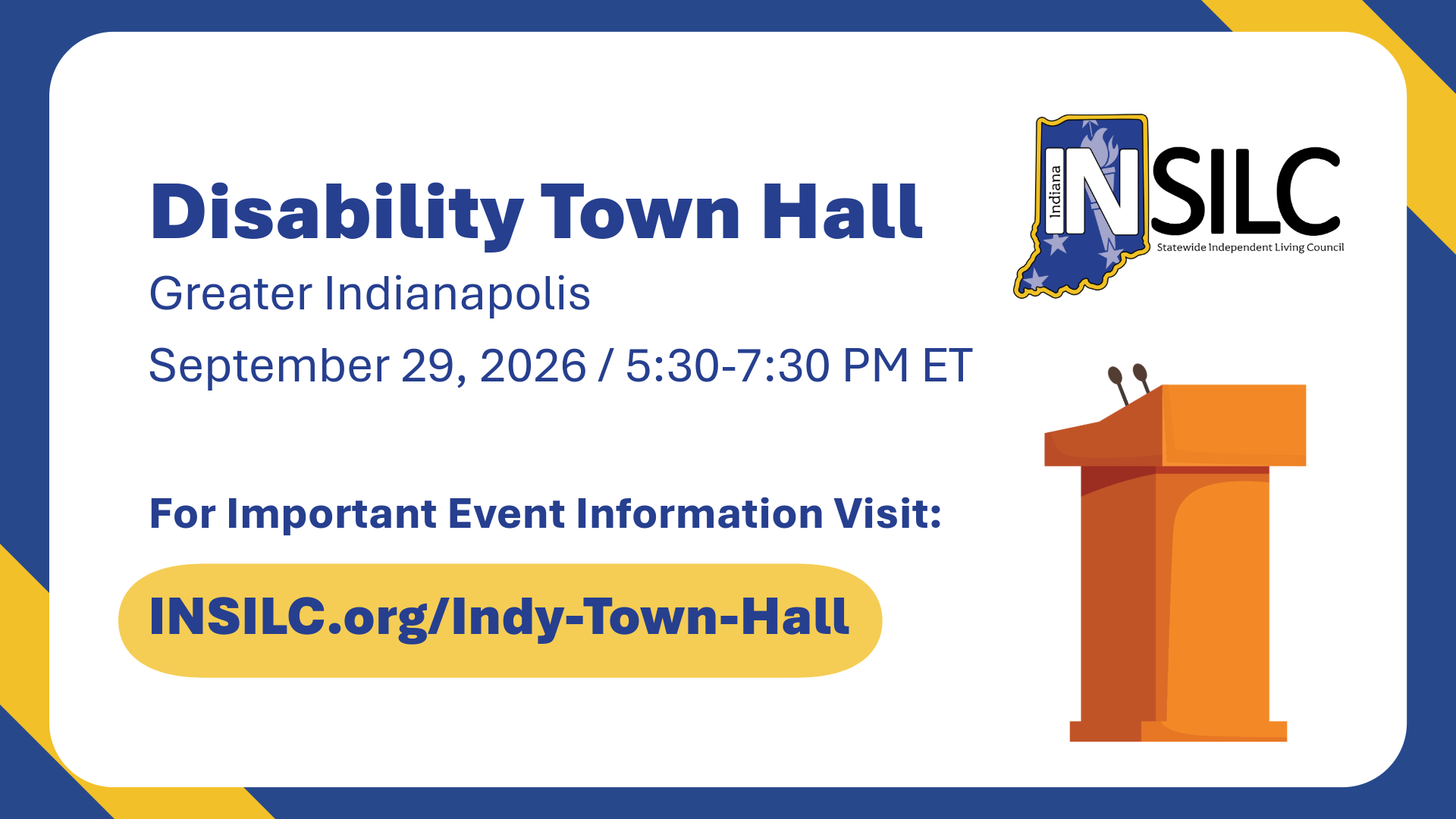
Greater Indianapolis Disability Town Hall
Tuesday, September 29, 2026 / 5:30-7:30 PM ET
Join INSILC for a Disability Town Hall at the Embassy Suites Conference Center in Noblesville, IN or via a live stream!
Event Details
Tuesday, September 29, 2026
5:30-7:30 PM ET
Embassy Suites Conference Center
13700 Conference Ctr Dr S, Noblesville, IN 46060
Event Timeline
- 5:40-6:00 PM – Welcome & Introductions
- 6:00-7:00 PM – Medicaid Waiver Reset Discussion & Q&A
- Cathy Robinson, Associate Director, Division of Disability, Aging and Rehabilitative Services, FSSA
- Holly Wimsatt, Director, Bureau of Disabilities Services, FSSA
- Kim Dodson, CEO, The Arc of Indiana (Facilitator)
- 7:00-7:30 PM – Attendees Visit Exhibitor Tables
Thank You to Our Snack Sponsor Molina Health!


Download Word Town Hall Transcript

Download PDF Town Hall Transcript
Medicaid Waiver Reset Discussion Summary
Thank you to Cathy Robinson, Holly Wimsatt, and Kim Dodson for joining us at the town hall. Below is a summary, organized by topic, of the discussion on waivers and home-based community services.
Kim Dodson Sets the Context
Kim explained that concerns about Indiana’s waiver system are not new. According to her, conversations about reform began around 2015, when families increasingly reported that the Family Supports Waiver and CIH Waiver were no longer meeting people’s needs. She noted that waiver redesign discussions gained momentum before being interrupted by COVID-19, then resumed around 2022 and 2023. Indiana is now at a point where significant changes to Medicaid waivers and eligibility assessments are being considered.
Kim acknowledged that the volume of changes can be overwhelming for families and people with disabilities. She noted that misinformation is circulating, particularly on social media, and that many people are struggling to separate facts from rumors. She framed the discussion as an opportunity for families to hear directly from state leadership.
Cathy Robinson Explains the State’s Intent
Cathy stated that Indiana had discussed moving to a different suite of assessment tools for years before implementation. She emphasized that the InterRAI rollout was intended to create a more valid and consistent eligibility process, not to remove people from services. She stressed multiple times that the goal is accurate assessment and eligibility determination, not reducing access to waiver supports.
Why Indiana Changed the Assessment System
Cathy Robinson Explains the State’s Intent
Cathy stated that Indiana had discussed moving to a different suite of assessment tools for years before implementation. She emphasized that the InterRAI rollout was intended to create a more valid and consistent eligibility process, not to remove people from services. She stressed multiple times that the goal is accurate assessment and eligibility determination, not reducing access to waiver supports.
How the New Assessment Process Works
Holly Wimsatt Explains Federal Requirements
Holly began by explaining that level-of-care assessments are federal requirements for Home and Community-Based Services waivers. These assessments must occur before an individual receives services and at least annually thereafter. She emphasized that assessments are designed to evaluate support needs broadly, not just determine waiver eligibility.
She described three primary components of the assessment process:
-
A guided interview
-
Direct observation of the individual
-
Review of records and documentation
Cathy Robinson Explains What Good Assessments Should Look Like
Cathy explained that assessments should not be simple checklists or yes/no questionnaires. Instead, they should be conversations about daily life and support needs.
Examples she provided included conversations about:
-
How a person gets ready each day
-
How they leave their home
-
What supports they require throughout their day
While individual conversations will naturally vary, she stressed that the assessment process itself should be consistent across assessors.
InterRAI Rollout and Quality Assurance Concerns
Holly Wimsatt Discusses Early Implementation Problems
Holly said Indiana launched the InterRAI assessment tools in January 2026 and has continuously monitored outcomes since implementation. As part of that monitoring, state staff review assessments, particularly when results suggest that someone may no longer meet eligibility criteria.
She reported that the state identified concerns during quality-review activities and instituted a temporary pause on reviews to conduct additional quality assurance work.
Issues Identified
Holly described situations where reassessments became necessary, including:
-
The individual was reportedly not present during the assessment.
-
Required assessment procedures may not have been followed.
-
Quality reviews identified concerns about how assessments were completed.
When those issues are found, individuals are reassessed by highly trained subject matter experts within the case management system.
Kim Dodson Raises Stakeholder Concerns
Kim specifically asked how the state responded to concerns brought forward by families and advocacy organizations.
Holly Wimsatt Describes Corrective Actions
Holly said the state responded by:
-
Conducting reassessments
-
Providing mandatory refresher training
-
Creating additional guidance materials
-
Holding monthly learning collaboratives
-
Conducting monthly webinars and training sessions
-
Increasing technical assistance for assessors
She emphasized that these changes were directly informed by stakeholder feedback.
Cathy Robinson Explains the Focus on Consistency
Cathy added that much of the state’s effort is now focused on improving consistency among assessors. Concerns raised by families frequently involved variations in how assessments were conducted, so Indiana has concentrated training and quality improvement efforts on standardizing the process.
Reassessments and Assessment Timelines
Kim Dodson Asks About Deadlines
Kim noted that families were concerned about how quickly reassessments needed to be completed and asked for clarification about timelines.
Holly Wimsatt Explains the State’s Approach
Holly explained that the number of reassessments has continued to grow as quality reviews identify additional cases requiring review. Because of this, Indiana extended reassessment timelines. She emphasized that:
-
Accuracy is more important than speed.
-
Assessments should never be rushed.
-
Timelines can be extended when circumstances require.
-
Individual needs take priority over administrative deadlines.
Communication with Families
Kim Dodson Requests More Communication
Kim asked what steps were being taken to improve communication and transparency with families.
Holly Wimsatt Describes Planned Resources
Holly explained that Indiana is collaborating with advocacy organizations to develop:
-
Fact sheets
-
Guidance materials
-
Family toolkits
-
Workgroups focused on family education
The purpose is to help individuals and families better understand the assessment process and know what to expect.
Artificial Intelligence and Misinformation
Holly Wimsatt Addresses Social Media Rumors
Holly specifically addressed concerns circulating online. She explained that assessments are completed and reviewed by people throughout the process. She stated clearly that:
-
AI is not used to conduct assessments.
-
AI is not used to review assessments.
-
AI is not used to make eligibility determinations.
Institutionalization, CRMNFs, and Community Living
Kim Dodson Raises Community Concerns
Kim stated that many advocates are worried about the future direction of disability services.
She clarified that her concern is not the reopening of large institutions but rather the possibility that policy changes could encourage larger congregate settings or group homes that are less community-integrated. She asked for clarification regarding CRMNF facilities.
Holly Wimsatt Explains CRMNFs
Holly explained that CRMNFs are:
-
Comprehensive Rehabilitative Management Needs Facilities.
-
Short-term transitional settings.
-
Designed for people with very complex behavioral and mental health needs.
-
Intended to provide intensive supports before transitioning individuals back to more integrated community settings.
She noted:
-
Indiana currently has one CRMNF.
-
Indiana previously had two.
-
One facility voluntarily closed in 2024.
-
The state is not planning expansion beyond previous capacity.
Cathy Robinson Addresses Institutionalization Concerns
Cathy added that Indiana currently lacks adequate transition options for some individuals leaving psychiatric hospitals, especially women. She also stated that:
-
State leadership has publicly affirmed they do not intend to return to institutional models.
-
Indiana has closed hundreds of institutional beds during the past several years.
-
The state’s focus remains community-based services and supports.
Holly Wimsatt Reinforces the Message
Holly emphasized that Indiana is serving more people through HCBS waivers than ever before and that there is no effort underway to return to widespread institutionalization.
Service Hours, Utilization Review, and Employment
Attendee Concern
An attendee described having support hours reduced despite working full time and argued that reduced supports could undermine employment and economic independence.
Cathy Robinson Responds
Cathy explained that reductions in service hours may result from:
-
Utilization reviews
-
Service plan reviews
-
Medicaid funding decisions
She noted that home and community-based services are not entitlement services and acknowledged that balancing available resources with individual needs can be challenging.
She also discussed Indiana’s adoption of the LifeCourse framework and encouraged service teams to help people build broader support networks and contingency plans rather than relying entirely on one funding source. She referenced lessons learned during COVID regarding the importance of backup supports.
Additional Clarification
When another attendee described a reduction in hours, Holly clarified that the new eligibility assessments themselves do not automatically reduce services. She explained that service reductions typically result from separate utilization review processes.
Cathy added that reductions often occur because reviews determine that services are being authorized beyond demonstrated need and encouraged individuals to review notices carefully and work with their case managers.
Advocacy and Telling Your Story
Online Question About Fighting Institutionalization
An online participant asked what advocacy steps could be taken to oppose forced institutionalization.
Holly Wimsatt
Holly again stated unequivocally that Indiana is not pursuing forced institutionalization and reiterated the purpose of CRMNFs as short-term transitional supports.
Cathy Robinson
Cathy said that one of the strongest advocacy tools available is sharing personal success stories. She noted that personal stories help decision makers understand the value of community living. She encouraged people to tell policymakers:
-
How community living works for them.
-
What supports contribute to their success.
-
Why community-based services matter.
New Applicants and Newly Diagnosed Individuals
Attendee Question
An attendee asked about people who are just entering the system and newly receiving diagnoses.
Holly Wimsatt
Holly explained that DDRS district offices:
- Provide information and referrals.
- Help connect families with services.
- Often refer families to organizations such as The Arc.
- Help connect newly diagnosed individuals with support networks and resources.
Housing and Independent Living
Attendee Question
A participant asked about affordable housing options beyond Section 8 and how individuals can remain independent without moving into facilities.
Holly Wimsatt
Holly acknowledged that housing remains a significant challenge and clarified that Medicaid waivers fund services and supports, not housing itself.
Cathy Robinson
She emphasized that solving housing challenges requires partnerships because DDRS does not directly control housing funding. Cathy described several efforts underway:
-
Partnerships with IHCDA.
-
Accessible housing set-asides in new developments.
-
Use of Money Follows the Person resources.
-
Exploration of tenancy-related supports through waiver redesign efforts.
Eligibility Standards and Waiver Access
Questions About Denials and Applying for Services
Near the end of the discussion, attendees asked about waiver denials, level-of-care standards, and how to apply for services.
Holly Wimsatt
Holly explained:
-
Different waivers have different level-of-care requirements.
-
Nursing facility level-of-care assessments may be completed by Maximus and may occur by phone.
-
Intellectual/developmental disability waiver assessments require face-to-face assessments.
-
Diagnosis alone is not sufficient to qualify for waiver services.
-
Federal eligibility standards require documented support needs in addition to diagnosis.
-
People seeking Health & Wellness Waiver services can begin by contacting their Area Agency on Aging.
This structure should map much more cleanly to your usual INSILC public comment and transcript coding process because the content is grouped around major themes while still preserving who raised each issue and how the discussion unfolded.
Download Word Discussion Summary
Download PDF Discussion Summary
Community Exhibitors
Thank you to our exhibitors! Learn more about the mission and services of each one by clicking on their name.
- accessABILITY Center for Independent Living
- ADA Indiana
- American Medicare Disability Advocates
- Autism Society of Indiana
- Bosma Enterprises
- Central Indiana Regional Transportation Authority – CIRTA
- Down Syndrome Indiana
- Indiana APSE: Advancing Employment, Connecting People
- Indiana Association of the Deaf
- Indiana DeafBlind Services Project
- Indiana Disability Rights
- Indiana Family to Family
- Indiana Governor’s Council for People with Disabilities
- The Arc of Indiana
Give Your Input on the State Plan
The State Plan for Independent Living is a roadmap of goals and activities that strives to improve access, choice, and opportunities for Hoosiers with disabilities.
Together INSILC and Indiana’s Centers for Independent Living work to hear from our peers with disabilities, apply what we learn to the plan, and then put the plan into action. A new State Plan is created every three years.
We Want to Hear From You!
The 2027-2030 State Plan Goals & Objectives are now available. You are invited to review them and share your thoughts and suggestions. These ideas are a draft. Your answers will help us decide what to keep, change, or add.
accessABILITY Center for Independent Living
accessABILITY is one of Indiana’s ten Centers for Independent Living serving Indianapolis and the seven surrounding counties. They provide services like information and referral, transition services, peer support, individual and systems advocacy, independent living skills training, and more. Visit their website or call 317.926.1660 to get started.
Event Overview
Join INSILC for its third town hall of 2026—a community gathering focused on elevating the voices of people with disabilities. The topic of this event is home and community-based services. Attendees will hear from FSSA leadership about the Medicaid Waiver Reset and have the chance to ask questions.
Ideas shared throughout the evening will help shape Indiana’s next State Plan for Independent Living, a roadmap of priorities and goals that strives to improve access, choice, and opportunities for Hoosiers with disabilities.
Reserve a Ride to the Event
We have met our limit for complimentary rides. We encourage you to attend the live stream! Share your email when registering, visit our website, or follow our Facebook to get the link.
Accessibility
ASL interpretation and CART services will be provided. Please request additional accommodations when registering.