
Celebrating Disability Pride Month 2026
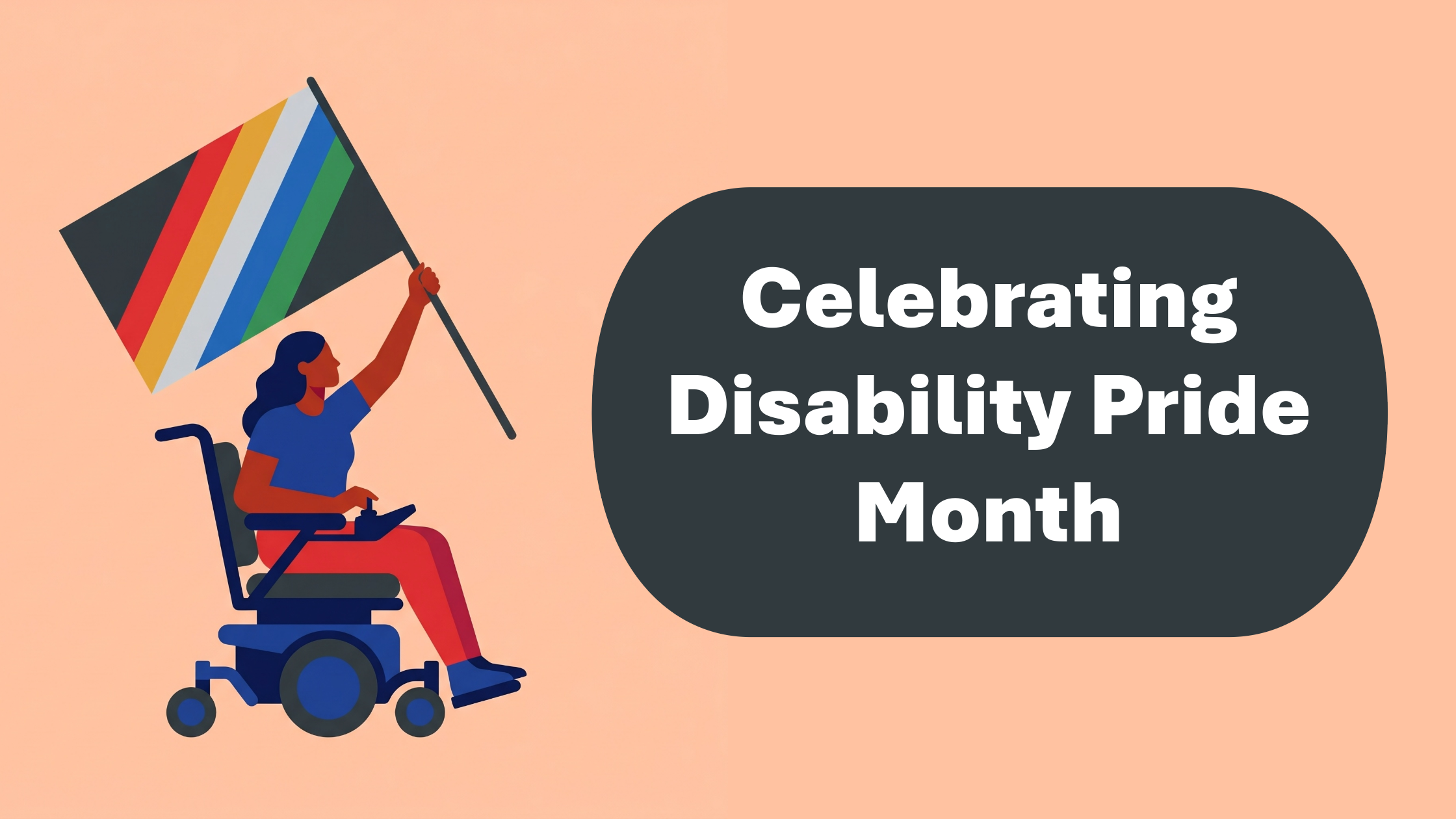
Illustration for Disability Pride Month showing a person using a powered wheelchair and holding a Disability Pride flag with diagonal stripes in red, gold, white, blue, and green on a black background. Large white text on a dark rounded rectangle reads, “Celebrating Disability Pride Month.” The background is a soft peach color.
Celebrating Disability Pride Month
Every July in the United States, we recognize and celebrate Disability Pride Month. During this month, we honor the achievements, identities, history, and contributions of individuals with disabilities, all while advocating for a more accessible and inclusive society. More than a commemorative month, Disability Pride Month is an opportunity to challenge misconceptions, celebrate diversity, and promote accessibility. Disability Pride Month encourages those with disabilities to embrace them, loud and proud.
Disability affects more than one billion people worldwide and approximately one in four adults in the United Statess. Despite these numbers, disability is continually misunderstood, stigmatized, and viewed primarily through a medical lens. Disability Pride Month encourages us to change that perspective. Instead of seeing disability as something that must be “fixed” or overcome, we view it as an important part of human diversity and identity.
For organizations like Independent Living Councils and Centers, Disability Pride Month serves as a reminder of the ongoing work needed to ensure that everyone can live independently, participate fully in their communities, and make their own choices.
The History of Disability Pride Month
You may be asking yourself, “Why July?” Well, Disability Pride Month commemorates the anniversary of the signing of the Americans with Disabilities Act (ADA), which was signed into law by President George H. W. Bush on July 26, 1990. Disability Pride Day was celebrated in 1990, but the first official Disability Pride Month occurred in July of 2015. The ADA was one of the most significant civil rights victories in American history. It prohibits discrimination against individuals with disabilities in employment, education, transportation, public accommodation, telecommunications, and government services. It strives to ensure that those with disabilities have the same access, rights, and opportunities as everyone else. It strives to ensure that those with disabilities have the same access, rights, and opportunities as everyone else.
It is important to recognize that the passage of the ADA did not happen overnight. For decades, disability activists demanded equal rights and greater accessibility for all, directly culminating in the passage of the law.
One of the most important moments in disability rights history was the “Capitol Crawl” in March 1990. Activists left their mobility devices behind and crawled up the steps of the U.S. Capitol to demonstrate the inaccessibility of public spaces and emphasize the urgent need for disability rights legislation. Their determination and bravery helped bring national attention to the importance of passing the ADA.

Image Description: Surrounded by fellow protesters, 8-year old Jennifer Keelan-Chaffins crawls up the U.S. Capitol steps on her hands and knees. Media personnel stand above the crowd and document the demonstration urging Congress to pass the Americans with Disabilities Act. [Photo Credit: Associated Press]
Today, Disability Pride Month honors these historic achievements while focusing on the work that still lies ahead.
What Does Disability Pride Mean?
The term “pride” can sometimes raise questions. Disability Pride is not about celebrating pain, illness, or the challenges that disability can so often bring. Rather, it is about embracing disability as part of one’s identity and celebrating what makes us different.
For generations, and to some extent still today, those with disabilities are taught to hide or view them as personal failures. Many have lost their lives due to violence, neglect, and ableism. Disability Pride rejects these narratives and encourages people to embrace their disability openly. It affirms that people with disabilities have inherent value, important perspectives, and provide meaningful contributions to society.
Pride also acknowledges that disabilities are diverse. They may be visible or invisible, congenital or acquired, temporary or lifelong. No two experiences are exactly alike, and every person’s journey deserves to be respected and valued.
The 2026 theme, “The World Works Better with Us,” encompasses the idea that including, respecting, and supporting, people with disabilities allows communities to function more effectively in every aspect.
The Social Model of Disability
One important concept often discussed during Disability Pride Month is the social model of disability.
The medical model views disability as a problem that exists within an individual and focuses on diagnosis, treatment, or cure.
The social model offers a different perspective. It suggests that people are often disabled not by their bodies or minds, but by the inaccessible environments around them, harmful policies, and attitudes.
Some real-life examples of this concept are:
- A wheelchair user is disabled by a building without a ramp, not by using a wheelchair.
- A Deaf individual is disabled when interpreters or captioning are not provided.
- Someone with a visual impairment encounters barriers when websites are not built to be compatible with screen readers.
- An individual with a disability is disabled when a workplace refuses reasonable accommodation.
This perspective shifts responsibility from individuals to society as a whole. It encourages communities to remove barriers rather than expecting people with disabilities to adapt to inaccessible environments.
The Importance of Independent Living
Independent Living Centers play a vital role in helping people with disabilities live independently and participate fully in their communities without barriers.
According to the National Council on Independent Living, “The Independent Living (IL) philosophy posits that individuals with disabilities have the same fundamental human rights, choices, and self-determination as non-disabled people. It emphasizes that people with disabilities are the ultimate experts on their own needs and should have full control over their lives, care, and living arrangements.” Nationwide, Independent Living Centers provide services that empower individuals to exercise choice and control while connecting them with resources that promote greater independence.
Equally important, Independent Living Councils and Centers can advocate for systemic changes that improve accessibility and eliminate discrimination throughout their communities.
At INSILC, we are currently looking for input on what changes are needed to make to a Statewide Plan for Independent Living. If you’d like to participate in shaping a more accessible and inclusive Indiana, consider joining one of our online forums to make your voice heard. Information about this can be found on our website.
How Everyone Can Support Disability Inclusion
Celebrating Disability Pride Month is not limited to individuals with disabilities. Everyone can help create more inclusive communities throughout the year.
Here are a few meaningful ways to get involved:
- Learn from disabled voices. Read books, watch documentaries, follow disability advocates, and listen to people with lived experiences.
- Use respectful language. Different people have different preferences regarding identity-first (“disabled person”) or person-first (“person with a disability”) language. When possible, ask individuals what they prefer and respect their choice.
- Advocate for accessibility. Encourage businesses, schools, workplaces, and community organizations to improve accessibility for everyone. Consider getting involved in protests or demonstrations.
- Challenge stereotypes. Disability is not synonymous with weakness, dependence, or tragedy. Speak up when you encounter harmful assumptions or misinformation. By doing this, we can change the way society views disability.
- Support disability-led organizations. Volunteer, donate, attend community events, or partner with organizations that promote disability rights and independent living.
- Create with inclusion in mind. Whether it be designing websites, hosting events, or developing programs, consider accessibility from the beginning rather than treating it as an afterthought.
Looking Ahead
Although significant progress has been made since the passage of the ADA, many barriers still exist.
People with disabilities continue to advocate for equitable employment opportunities, accessible and affordable housing, affordable healthcare, reliable transportation, inclusive education, and digital accessibility. As technology and society evolve, accessibility must evolve alongside them.
Disability Pride Month reminds us that inclusion is not a one-time commitment, but an ongoing commitment.
Celebrating Disability Pride Everyday
Disability Pride Month is ultimately about recognizing that disability is an essential part of human diversity. It celebrates resilience, innovation, advocacy, and community while acknowledging the work that remains.
At its heart, Disability Pride is about belonging. It is about ensuring that every individual can live independently, pursue their goals, and contribute without unnecessary barriers.
As we celebrate this July, let us honor the advocates who fought for disability rights, recognize the achievements of people with disabilities today, and continue building communities where accessibility and inclusion are the standard, not the exception.